
What expansive clay does
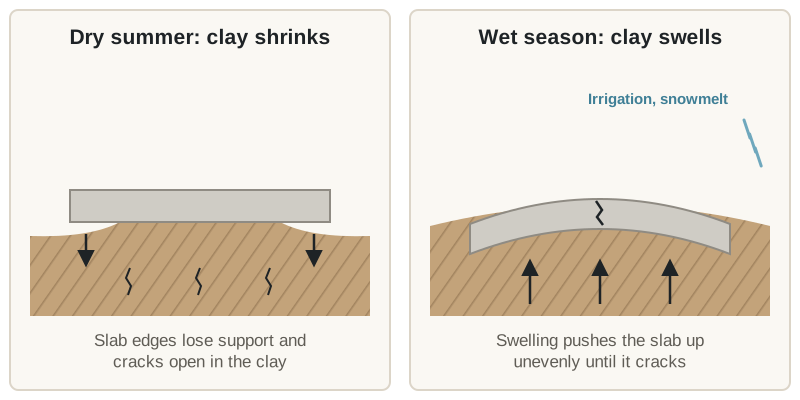
Some clays soak up water like a sponge. When they get wet they swell, and when they dry out they shrink. Not a little, either. A clay with high shrink-swell potential can push hard enough to lift a sidewalk, crack a driveway or tip a patio back toward the house.
The trouble with a slab is that it sits right on top of that movement. When the edges dry out faster than the middle (or get watered more than the middle), the clay moves unevenly and the slab bends until it cracks.
Where it shows up around Reno
The worst of it is in the closed basins north of town. Spanish Springs Valley is old lakebed and some of the most expansive ground in the area. Parts of north Sparks, Lemmon Valley, Cold Springs and the low spots in Sun Valley have it too. You'll also find pockets of clay elsewhere around the Truckee Meadows, which is why we dig a test hole instead of assuming.
Why lawns and sprinklers make it worse
Before the houses went in, that clay went through one slow wet-dry cycle a year. Then came lawns, drip lines and sprinklers. Now the clay at the edge of a patio might get soaked three times a week in July while the clay under the middle stays dry. That uneven wetting is exactly what makes slabs crack and tip.
How we pour on it
- Dig out deeper. We take out the top layer of clay under the slab and replace it with crushed rock that doesn't swell. The more distance between the clay and the concrete, the less the slab feels it.
- Wet the clay first. Pouring on clay that's dried out and shrunk in August is how slabs end up lifting later. We moisture-condition it before the pour.
- Go thicker, with real steel. A thicker slab with rebar up on chairs can ride out small movements instead of snapping.
- Cut joints closer together. So any cracking happens in straight lines where we put it.
- Get the water away. Downspouts extended past the concrete, sprinklers aimed away from the edges, and grade sloping away from both the house and the slab.
Living with a slab that's already there
If you've already got concrete on clay, a few habits help a lot. Keep the watering steady instead of soak-and-bake. Point sprinkler heads away from slab edges. Make sure downspouts don't dump next to the concrete. And seal cracks so water can't get under the slab through them.
Did it heave or settle?
A slab that's moved has either gone up or come down, and the fix depends on which. Swelling clay pushes slabs up, usually in the middle or along one edge. Settling fill drops them, usually along the house where foundation backfill was never compacted. From above they can look a lot alike.
If the slab is still in one piece, lifting is often the cheaper fix. If it's broken up, replacing it and fixing the ground underneath is the better use of your money. Not sure which one you've got? Call us at (775) 264-5350 and we'll come take a look.